First Bus London case study: solved a 500-driver shortage and achieving a £500 cost per hire

The challenge
First Bus London is a large, multi-site transport operator in London, hiring at high volume across around ten depots and locations. Like many organisations recruiting in competitive frontline markets, they faced a double challenge: a significant shortage of drivers and a pipeline that wasn’t reliably producing the right people.
Before working with McRoberts, the business was dealing with hundreds of vacancies, slow hiring cycles and an overreliance on agency drivers. Candidate volume wasn’t high enough to meet demand—yet even when applications came in, quality was inconsistent. That combination created operational pressure, slowed down growth and made it harder for internal teams to stay on top of recruitment.
What First Bus London needed wasn’t simply more applications. They needed a predictable, on-demand flow of high-quality candidates, at scale.
What success looked like
Success was defined by two things:
- High volumes of quality candidates (not just leads)
- Accelerated hiring outcomes with less wasted time
Operationally, that meant improving the end-to-end conversion from application to hire, reducing time-to-hire, lowering recruitment cost per hire, and strengthening long-term retention by improving fit at the point of entry.
McRoberts tracked performance through a recruitment funnel lens, focusing on metrics that matter in volume hiring:
- Volume of quality candidates delivered
- Conversion rate from candidate to hire
- Total hires achieved
- Time saved for internal teams
- Retention improvements over time
Our approach
McRoberts applied digital recruitment marketing techniques to high-volume frontline hiring—combining strong employer messaging, performance marketing, and structured screening to protect quality.
We began by building a role-specific employer value proposition that spoke clearly to what candidates care about and what makes someone successful in the role. That messaging was then deployed across the entire journey—from the first ad impression to the point a candidate enters the client’s ATS.
From there, we focused on two principles:
- Attract the right people through targeted channel strategy and high-performing creative
- Filter for reliability and fit through a structured screening process that reduces no-shows, drop-outs and early leavers
What we delivered
To deliver high-quality candidates on demand, we built a recruitment engine designed for scale.
1) Multi-channel attraction (built for performance)
We ran campaigns across:
- Search engines
- Social media
- Job boards and other relevant channels
- …ensuring First Bus London consistently reached the right audiences across London.
2) Original, high-quality content from the depots
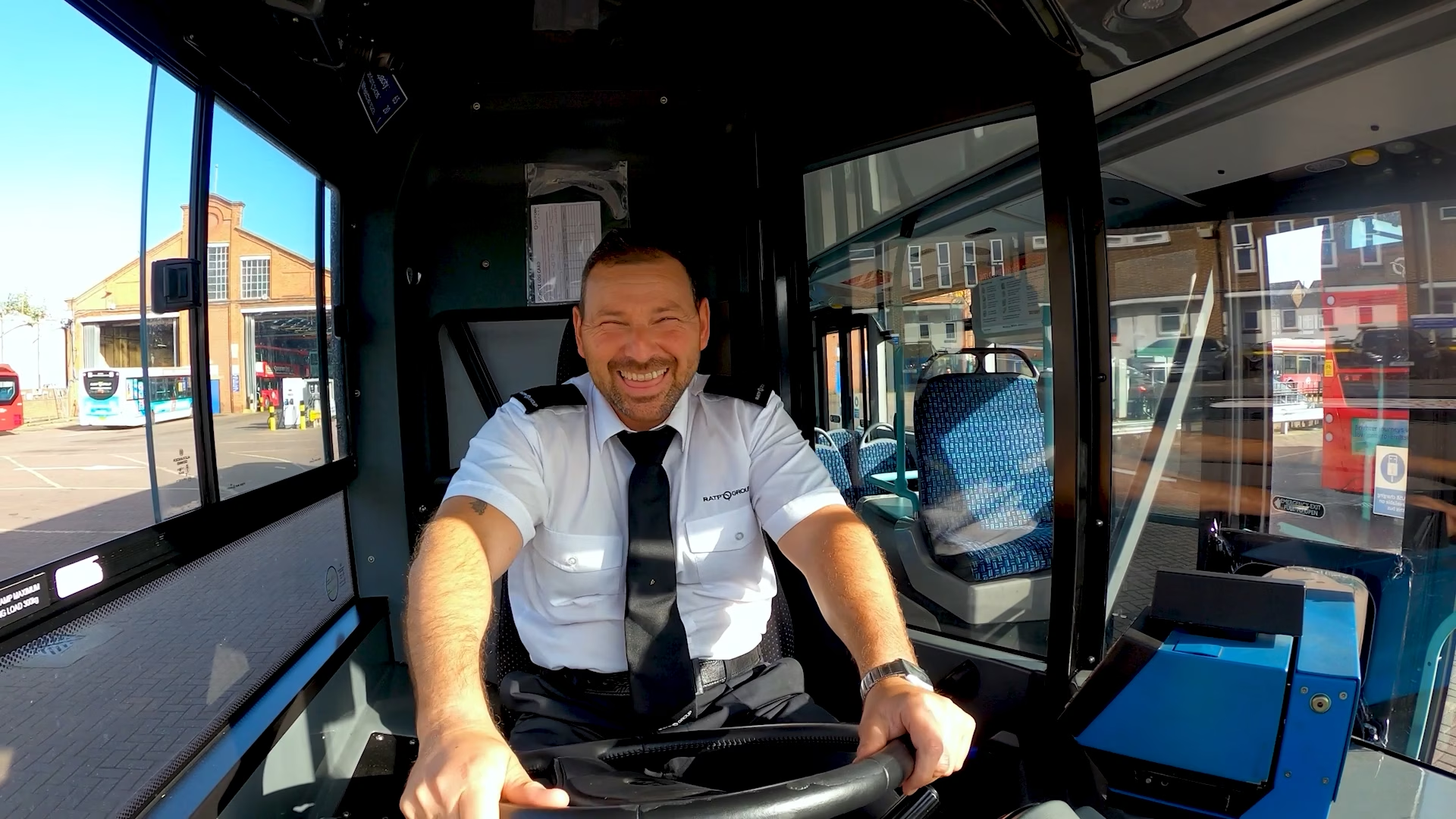
We created original video content on-site—filming inside depots and interviewing drivers and bus schedulers—to produce engaging, credible recruitment assets. This significantly improved performance across touchpoints by building trust and helping candidates understand the reality of the role.
3) Targeted landing pages built to convert
Candidates were directed to tailored landing pages featuring:
- Clear role propositions
- Testimonials and proof
- Video content
- Expectation-setting that improves fit and reduces drop-off
4) Structured screening to protect quality
Every applicant moved through a screening process designed to ensure only high-quality candidates progressed. This included expectation management and practical fit checks—such as commute-time screening—to ensure candidates could reliably reach depot locations and sustain the role long-term.
5) Automated re-engagement for drop-offs
Where candidates dropped out of the funnel, McRoberts used automated email and SMS follow-up to re-engage and recover strong prospects—keeping the pipeline healthy without adding manual workload to internal teams.
6) ATS delivery (no disruption to internal workflows)
Candidates who passed screening were delivered directly into the client’s applicant tracking system, allowing internal teams to work within their existing process while benefiting from better candidate quality and volume.
This approach was applied across both PCV driver and trainee driver recruitment, with additional campaigns for bus schedulers.
Results
McRoberts helped First Bus London build a recruitment engine capable of delivering quality candidates at scale.
Over time, the programme delivered:
- 250–500 driver hires per year (approx.)
- Extremely low cost per hire (approx. 2% / ~£250 per hire)
- ~70% reduction in time-to-hire
- ~20% savings in hiring cost/effort
- ~20% improvement in staff retention (via improved fit, screening and process)
Crucially, the partnership prioritised quality: the focus was on ensuring that every person interviewed met a high bar, reducing wasted interviews, improving hiring manager confidence, and creating more predictable outcomes.
Why it worked
This programme succeeded because it treated frontline recruitment as a performance system—built on messaging, targeting, content, screening and iteration.
Key drivers of success included:
- Role-specific EVP and clear expectation-setting, improving fit
- High-performing creative and original video content, increasing trust and conversion
- Structured screening (including commute-time filtering), improving reliability and reducing churn risk
- Automation and re-engagement, reducing drop-off without increasing admin
- Relentless optimisation, using data to continually improve performance
- A responsive partnership style: acting quickly, improving quickly, and delivering consistently
What this enabled next
With a predictable pipeline of quality candidates, First Bus London could reduce reliance on agencies, speed up hiring, and stabilise staffing across multiple depots. The system also created a foundation for expanding campaigns across additional roles and continuously improving retention outcomes over time.
Issues that the client faced
High employee turnover
Reliance on agency staff
Attracting the wrong candidates
Recruitment disrupting operations
Hiring issues damaging reputation
Recruitment impacting customer experience
Expensive hiring process
Slow time-to-hire
Narrow candidate reach
Weak employer brand
Services we used to solve the issues:
The results we achieved


Case Study Video Review
Discover other cases